Niche Job Boards: When Specialized Sites Beat General Ones

Help shape a future CV tailoring tool. Start the JobTide early-access questionnaire →
Yes, niche job boards are worth your time if you have a specific skill, credential, or role that a general board buries under thousands of unrelated postings. They work best in two scenarios: when you have specialized technical skills (data engineering, drone piloting, clinical research) that need precise keyword matching, and when you’re in a tightly defined profession (aviation, trust and safety, Linux administration) where employers actively hunt in smaller pools. Platforms like Jobtide apply this same logic through personalized matching, so you get niche-level relevance without hunting across a dozen separate sites.
Use niche boards when:
- You have a credential or skill that filters well as a keyword (RN license, AWS certification, FAA rating)
- You’re tired of competing with hundreds of generic applicants for the same role
- You want alerts for roles that rarely surface on mainstream sites
Key Takeaways
Niche job boards deliver better results than general boards specifically when your role has a searchable skill, credential, or terminology that filters well.
| Point | Details |
|---|---|
| Use niche boards for specificity | Prioritize them when you have a clear technical skill or credential to filter on. |
| Check the pricing model | Employers paying $150 to $450 per posting tend to have genuine hiring intent. |
| Watch community channels first | Roles often circulate on Slack, subreddits, or GitHub before a formal posting appears. |
| Prioritize relevance over volume | A small, targeted board can outperform a massive general platform for the right niche. |
| Consider Jobtide for broader personalization | Jobtide applies niche-level filtering and skill matching across a wider range of roles without requiring multiple accounts. |
Table of Contents
- What Are Niche Job Boards and Why Do They Matter?
- How to Find and Evaluate the Right Niche Job Boards
- High-Value Niche Categories Worth Watching
- How Jobtide Applies the Niche-Board Advantage
- What Employers Typically Pay to Post on Niche Boards
- Tips for Employers Posting on Specialized Boards
- Measuring Whether a Niche Board Posting Is Working
- Where Niche Job Boards Are Headed
- Strategies for Job Seekers to Get the Most Out of Niche Boards
- What the Data Actually Supports
- Get Personalized Job Matching With Jobtide
- Sources
What Are Niche Job Boards and Why Do They Matter?
Niche job boards are job platforms built around a single industry, role, skill set, or hiring model instead of trying to cover every profession at once. Think a board exclusively for UX designers, one just for commercial pilots, or one built around remote-only engineering roles. The narrower the focus, the sharper the match between who’s posting and who’s applying.
That focus produces a real advantage: higher signal, less noise. When employers and candidates both show up for the same specific reason, the signal-to-noise ratio improves dramatically compared to mass-market boards where a single posting might pull in thousands of unqualified applications. Employers who choose a niche board over a general one usually do it deliberately, which tells you something about their hiring intent before you even open the listing.
The benefits stack up quickly:
- Relevance: listings match your actual skill set instead of loosely adjacent roles
- Less competition: smaller applicant pools mean your application doesn’t disappear in a pile of 500
- Higher employer intent: companies paying to post on a specialized board are usually further along in defining what they need
- Targeted alerts: you stop wading through irrelevant notifications
Niche boards aren’t a universal fix. If you’re hunting for a broad entry-level role, general retail work, or you simply need maximum volume of options, a specialized board’s smaller pool will frustrate you more than help you. Niche boards trade breadth for precision, and that trade only pays off when precision is what you actually need.
How to Find and Evaluate the Right Niche Job Boards
Finding the right board takes more than a quick search. Here’s how to do it properly.
- Search with niche-specific keyword strings. Instead of “marketing jobs,” try “growth marketing jobs SaaS” or “clinical research associate jobs oncology.” Specific phrasing surfaces specialized sites that generic terms miss.
- Check community resources first. Many niche roles get posted in subreddits, Slack groups, or Discord servers before they ever hit a formal board. Community channels often carry listings that never make it to employer bulk-posting tools.
- Look at professional associations. Trade groups and licensing bodies (nursing associations, bar associations, pilot unions) frequently run their own job boards as a membership benefit.
- Scan portfolio and marketplace hubs. Creative and technical fields often have vetted marketplaces where employers browse work samples directly rather than resumes.
- Run your evaluation checklist before committing time. Look for listing freshness (are postings updated weekly or stale for months?), recognizable employer names, overall job volume, how the board charges employers, how clear the application process is, and whether the board shows any signal about candidate quality expectations.
- Set up alerts and build a niche-tailored profile. Generic resumes underperform on specialized boards. Tighten your CV language to match the exact terminology the niche uses, then use boolean search operators (AND, OR, NOT) to cut down on irrelevant matches.
Pro Tip: Combine direct board alerts with community signals like Twitter, GitHub, or Slack. Many specialized roles get filled through reputation and word of mouth before the listing ever goes public, so catching it early on a community channel can put you ahead of the formal posting.
High-Value Niche Categories Worth Watching
Not every niche is worth your ongoing attention, so prioritize based on where your skills overlap with clear demand.
- Tech (developers, data, site reliability): developer-focused boards and marketplaces remain some of the most consistently effective niche channels, particularly for backend, data, and infrastructure roles.
- Creative and design: portfolio-driven marketplaces let employers evaluate actual work samples, which favors designers and illustrators over resume-first screening.
- Healthcare: licensing-body boards and specialty hospital networks post roles that rarely surface on general sites.
- Aviation: verified, curated boards like industry-specific pilot and crew platforms improve match quality in a field where credentials matter enormously.
- Climate and sustainability: mission-driven boards connect candidates directly with employers building out ESG and renewable energy teams.
- Specialized trades: licensing associations and union job boards often list roles months before they appear anywhere else.
- Remote-only marketplaces: vetted platforms for fully remote work filter out location-restricted noise entirely.
| Category | Where to Look |
|---|---|
| Tech (dev, data, SRE) | Developer marketplaces, GitHub job threads |
| Creative and design | Portfolio hubs, design community boards |
| Healthcare | Licensing associations, hospital network sites |
| Aviation | Verified pilot and crew platforms |
| Climate and sustainability | Mission-driven job boards |
| Specialized trades | Trade union and licensing body boards |
| Remote-only roles | Vetted remote work marketplaces |
Prioritize categories where you have the strongest skill overlap and where demand signals (steady posting volume, senior-level roles, competitive pay) are visible. A niche with only a handful of listings a month can still be worth watching. Some specialized boards remain viable with as few as 50 active listings if the employers on them are genuinely committed to reaching that concentrated audience.
How Jobtide Applies the Niche-Board Advantage
Jobtide isn’t a single-industry board, but it’s built to replicate what makes niche boards work: precision over volume. The platform’s skill-based filters and personalized recommendation engine narrow down listings the same way a specialized board does, just without requiring you to hunt across a dozen separate sites for different parts of your search.
That matters most for job seekers who benefit from a targeted profile but don’t want to manage accounts on five different niche platforms. Jobtide’s approach includes:
- Filtering by specific skills, certifications, and role criteria rather than broad job titles
- Tailored recommendations based on your actual profile, not generic keyword matches
- Fewer irrelevant applications sent, which improves how hiring teams perceive your candidacy
A more targeted application process doesn’t just save time. It changes how you show up to employers. Sending fewer, better-matched applications signals focus, and hiring teams notice the difference between a candidate who applied broadly and one who applied deliberately.
Jobtide is still in its launch phase, and the roadmap includes expanded matching tools and deeper employer integration as the platform grows.
What Employers Typically Pay to Post on Niche Boards
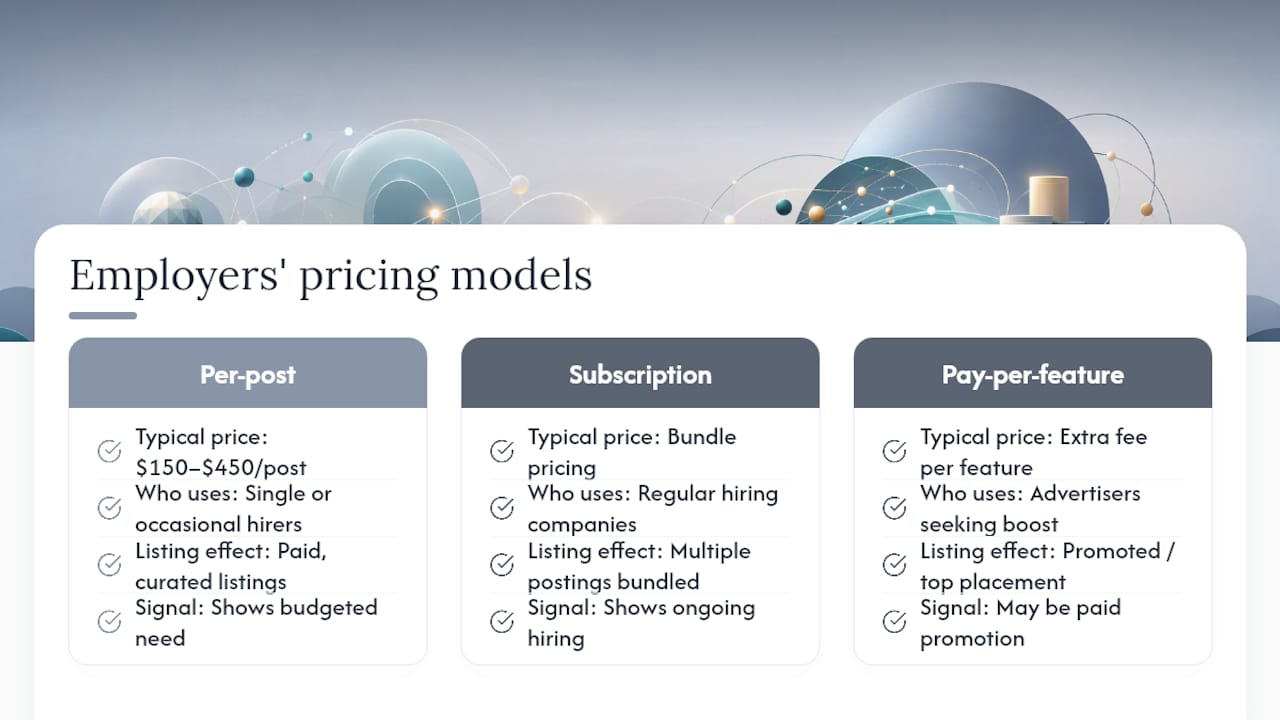
If you’re wondering why a niche board bothers to exist with a fraction of the traffic of a major platform, the answer is usually the pricing model. Specialized job boards commonly charge employers between $150 and $450 per posting, depending on the industry and how long the listing stays live. That’s a meaningful price for a single job ad, and it tells you something important as a job seeker: employers paying that much aren’t posting on a whim.
Some niche boards use flat per-posting fees. Others bundle postings into subscription packages for companies that hire regularly in that field, similar to how broader platforms structure employer subscriptions. A smaller number run on a pay-per-application or featured-listing model, charging extra to push a posting to the top of search results or into a curated newsletter.
For you as a candidate, the pricing model is a useful signal. A board charging employers real money to post tends to attract companies with a genuine, budgeted need rather than a speculative one. Free-to-post boards can still carry good listings, but they’re also more prone to spam, expired postings, and roles that never actually existed. When you’re evaluating a new board, checking whether employers pay to be there is a quick way to judge whether the platform has real skin in the game.
Tips for Employers Posting on Specialized Boards
Employers get more out of niche boards when they write postings for the audience actually reading them, not a generic template pulled from a general job site. Specificity is the entire value proposition of a niche board, so a vague listing wastes the placement.
Effective postings on specialized boards usually:
- Lead with the technical requirement or credential up front, not buried in paragraph three
- Use the exact terminology the niche community uses (a “site reliability engineer” listing should say SRE, not just “IT support”)
- Include salary range, since niche audiences compare pay more actively within their own field
- Link to real project examples or team structure instead of generic mission statements
- Get posted directly into community channels (Slack groups, subreddits, association newsletters) in addition to the board itself, since many niche hires start through community-sourced listings rather than the formal posting alone
Employers who treat a niche board like a smaller version of a general board tend to underperform. The candidates browsing a specialized platform already know the field well enough to spot a generic posting immediately, and they’ll scroll past it.
Measuring Whether a Niche Board Posting Is Working
The metrics that matter on a niche board aren’t the same ones that matter on a general platform. Raw application volume is close to meaningless here. A tech-specific board might send an employer 15 applications compared to 300 from a general site, but if 12 of those 15 are genuinely qualified, that’s a far better outcome.
The metrics worth tracking:
- Applicant-to-qualified ratio: what percentage of applicants actually meet the core requirements
- Time-to-fill: whether the niche board’s targeted audience shortens the hiring cycle compared to general boards
- Source-of-hire data: tracking which board actually produced the eventual hire, not just the most applications
- Cost-per-qualified-applicant: dividing the posting fee by the number of genuinely relevant applicants, not total applicants
For job seekers, the equivalent self-check is simpler: track your response rate by platform. If a niche board is producing more interviews per application sent than a general board, that’s your evidence it’s worth the continued time investment. Most applicant tracking systems used by employers already break down source data this way, which is part of why niche boards keep earning renewed budget even at a higher per-posting cost.
Where Niche Job Boards Are Headed
The trend line points toward more fragmentation, not less. As remote work normalizes across borders, niche boards built around specific work arrangements (remote-only, contract-based, four-day-week employers) are growing alongside the traditional industry-specific model. Expect more boards built around a hiring philosophy rather than just a job category.

Verification is also becoming a bigger differentiator. Boards that vet employers or confirm candidate credentials before listing, the way some aviation-focused platforms already do, are positioning themselves against the spam and expired-listing problems that plague looser platforms. That kind of curation is expensive to maintain, which is likely why it stays concentrated in higher-stakes fields for now.
Mission-driven boards are another growth area worth watching. Platforms built specifically to connect underrepresented candidates with employers prioritizing inclusive hiring are carving out a durable niche of their own, separate from industry or skill-based boards entirely.
The likeliest long-term shift is toward platforms that blend the precision of a niche board with the reach of a general one, using personalization to narrow results without forcing job seekers to manage accounts across a dozen separate specialized sites. That’s the gap platforms with matching technology are built to close.
Strategies for Job Seekers to Get the Most Out of Niche Boards
Treat niche boards as a complement to your broader search, not a replacement for it. The strongest approach uses two or three niche boards alongside general platforms, rather than betting everything on one specialized site.
A few tactics consistently outperform a passive approach:
- Set alerts on multiple niche boards simultaneously rather than checking each one manually, since specialized roles can fill fast in a small applicant pool.
- Tailor your profile language to match the niche’s own terminology. A generic resume undersells you on a specialized board where recruiters are scanning for specific keywords.
- Treat community channels as an early-warning system. Insights from developer and tech job board data show many niche roles circulate informally before a formal posting goes live, so a Slack group or subreddit often beats the board itself for speed.
- Reassess which niches deserve your attention every few months, since demand shifts and a board that was active last year may quiet down as hiring patterns change.
The goal isn’t finding every niche board that exists. It’s identifying the two or three that actually match your specific skill set and treating them as a serious part of your weekly search routine, not an occasional check-in.
What the Data Actually Supports
Most advice about niche job boards treats them as a nice-to-have, something to try after exhausting general platforms. That gets the priority backward. If your role has a clear, searchable credential or skill, a niche board should be your first stop, not your last resort.
The overlooked nuance is that scale doesn’t determine value here. A board with a few dozen active listings can outperform a massive platform if the employers on it are genuinely targeting your exact profile. Job seekers chasing volume over precision consistently waste time on applications that were never competitive to begin with.
What I’d prioritize first: identify whether your skill set has a searchable credential or terminology at all. If it does, niche boards deserve real weekly attention. If your background is broader or more generalist, a platform that personalizes matching across a wider pool, rather than a single-industry board, will likely serve you better.
— Alisher
Get Personalized Job Matching With Jobtide
If a specialized board isn’t built for your exact field, or you don’t want to manage separate accounts across several niche sites, Jobtide gives you the same precision through personalized matching instead of a single-industry focus. The platform filters listings against your actual skills and preferences, so you spend less time scrolling past roles that were never a fit and more time on ones that are.
That matters most for recent graduates, career switchers, and freelancers juggling multiple types of roles at once, exactly the profiles that don’t fit neatly into one niche board’s category. Jobtide’s tailored recommendations narrow the noise the way a specialized site would, without requiring you to identify which of a dozen niche boards actually covers your situation. Employers get a comparable benefit on the hiring side, since the same matching engine surfaces more relevant candidates instead of a flood of unqualified applications.
If you’re ready to see how personalized filtering compares to the general job boards you’re using now, create your profile on Job Tide and set up your first set of tailored recommendations.
Sources
Help shape JobTide.
Tell us about your job search in our early-access questionnaire. JobTide is in development; completing it does not generate a resume.
Start my questionnaire →