UK Returners: Land a Paid 15 Week Returnship Without Guesswork

Help shape a future CV tailoring tool. Start the JobTide early-access questionnaire →
A returnship program is a paid, short-term fellowship, commonly lasting several weeks to a few months, built for professionals returning after a career break of a year or more. You work real assignments, get a mentor, and join a cohort of peers in the same situation. Most programs are structured to evaluate you for a permanent role, which means a returnship is less a training course and more a job tryout with a paycheck.
TL;DR:
- Most returnships last from several weeks to up to six months and pay a salary or stipend, emphasizing real work and mentorship.
- Applicants should focus on functional alignment, confirm pay and conversion rates, and target programs with clear mentorship and success metrics.
- Seasonality dictates application windows, so setting alerts on employer and specialist job sites beforehand improves chances of timely application.
- Relying solely on employer pages is inefficient; specialist indexes and filtering platforms like Jobtide can streamline matching and application processes.
- Returnship success depends on matching prior experience to the role, proactive preparation, and understanding the program’s structured evaluation for permanent hire potential.
Table of Contents
- What Are Returnship Programs and Who Runs Them?
- What a Typical Returnship Includes: Duration, Pay, and Outcomes
- How Do You Choose the Right Returnship Program?
- Building an Application Timeline That Actually Works
- Why Returnships Work for Employers and Returners Alike
- The Hardest Parts of a Returnship, and How to Manage Them
- How Returnships Support Diversity and Inclusion Goals
- Which Companies Run Notable Returnship Programs?
- Job Tide’s Role in Finding the Right Returnship Fit
- Getting Back to Work Without Guessing
- Find Cohort-Based Returnship Opportunities With Jobtide
- Sources
What Are Returnship Programs and Who Runs Them?
You will find returnships concentrated in finance, technology, engineering, and professional services, the industries with the deepest pockets for structured talent programs and the clearest business case for winning back experienced workers who left for caregiving, health issues, or other life reasons.
Large employers tend to run these on a fixed calendar rather than as ongoing open enrollment. A bank might open its spring cohort in February and its fall cohort in September, with a hard application window in between when the careers page shows nothing available. That is normal, not a dead end. Morgan Stanley’s Return to Work program, for instance, runs on set cohort timing rather than rolling admissions.
Because individual employer pages come and go with each cohort, relying on one company’s careers page is a poor strategy. A better approach:
- Check specialist indexes like iRelaunch, which track returnship listings across employers and update as new cohorts open.
- Follow specific employer program pages directly, since firms like Goldman Sachs and BlackRock publish their own dedicated returnship pages.
- Set calendar reminders around the seasons your target employers historically open applications, rather than checking randomly.
- Use a job platform that lets you filter for cohort-based or career-return roles specifically, so you are not sifting through standard postings by hand.
Treat “no positions available” as a scheduling fact, not a rejection.
What a Typical Returnship Includes: Duration, Pay, and Outcomes
Most returnships last around a few months, though some extend up to six months depending on the employer and function. Goldman Sachs describes its returnship as a paid, structured fellowship lasting a few months, and JPMorgan Chase’s ReEntry Program runs a similar paid fellowship with mentorship and professional skills workshops built in.
Pay is the detail worth confirming before you apply anywhere. Legitimate returnships pay a salary or stipend for the full duration. If a program calls itself a “returnship” but offers no compensation, that is a mismatch with how the term is used across the industry, and you should ask directly what the pay structure is before investing time in the application.
Pro Tip: Ask for the pay rate and conversion statistics in your first conversation with a recruiter. A program that cannot tell you either number in plain language is one you should scrutinize harder.
The structure across most programs looks similar:
- Real on-the-job assignments tied to a specific team, not shadow work or busywork.
- Formal workshops on updated tools, industry changes, or skills that atrophy during a break.
- A named mentor plus a “buddy” for day-to-day questions, a pairing JPMorgan Chase builds directly into its first-week onboarding.
- Cohort events, so you are networking with other returners rather than reentering alone.
The outcome most employers design for is conversion. A returnship functions as an extended interview: you get paid to prove you can still do the job, and the employer gets weeks of direct evidence before committing to a permanent hire. That framing should shape how you behave in the role, not just how you apply to it.
How Do You Choose the Right Returnship Program?
Not every returnship fits every returner, and applying broadly wastes time better spent on programs where you actually have a shot. Run through this sequence before you submit anything:
- Check the eligibility filter first. Most programs specify a minimum career break, often around two years, and a target seniority level. If a listing requires “two years out” and you took fourteen months off, that filter is usually automated and recruiters rarely override it, so don’t spend hours on an application that gets screened out before a human sees it.
- Match the function, not just the industry. A marketing returner applying to a data analytics cohort is fighting an uphill battle regardless of how strong the résumé looks. Career-reentry guidance from the UK consistently points to functional alignment, not generic “returner” positioning, as the strongest predictor of success.
- Confirm pay and format. Ask whether the role is full-time or part-time, remote, hybrid, or on-site, and whether pay is salaried or a flat stipend.
- Ask about conversion directly. A reasonable recruiter question is: “What percentage of your last cohort received permanent offers?” Vague answers are a signal worth noting.
- Confirm mentor and buddy structure exists on paper, not just in marketing copy. Programs that skip this step tend to leave returners isolated during the hardest weeks of reentry.
Watch for red flags: unpaid “returnships” (a mislabeling of an internship), no clarity on what happens at the end of the term, or a program with no named mentor system at all. These are not automatic disqualifiers, but they are reasons to ask harder questions before you commit three months of your life.
Pro Tip: Keep a running shortlist of three target employers rather than applying wide. Deep preparation for three well-matched programs beats shallow applications to fifteen.
Building an Application Timeline That Actually Works
Cohort-based hiring rewards preparation, not speed. The sequence that tends to work:
- Months out: Set alerts on employer career pages and specialist boards, since seasonality means windows open and close on fixed schedules rather than staying open year round.
- Weeks before the window opens: Update your résumé to explain the break in one clean line (“Career break for caregiving, 2023 to 2025”) rather than leaving a gap unexplained or over-justifying it.
- During application prep: Pull two or three concrete examples of impact, even from freelance work, volunteering, or upskilling during your time off. Recency matters more than most returners assume.
- After you’re accepted: Use the mentor and buddy system immediately rather than waiting to “figure things out” quietly. Programs build these supports because early integration predicts later performance.
- Before interviews: Refresh the specific technical or software skills your target role uses now, since tools and platforms shift fast during multi-year breaks.
Pro Tip: Frame your career break as a skills story, not an apology. “I managed a household budget and coordinated three caregivers” translates directly into project management language recruiters recognize.
Treat the fellowship itself as an audition where rapid learning and visible collaboration matter more than perfection in week one.
Why Returnships Work for Employers and Returners Alike
Employers get a low-risk way to rehire experienced talent they might otherwise screen out through automated résumé filters that flag employment gaps. A candidate who left the workforce for two years but has ten years of prior experience represents exactly the kind of hire a returnship is designed to surface, without the employer committing to a permanent offer on day one.
Returners get something equally valuable: a paid runway back into the workforce that comes with a support structure most direct-hire roles skip entirely. Starting a new job cold after a multiyear break is disorienting. Starting it with a mentor, a cohort of peers in the same position, and an explicit runway toward conversion changes the psychology of the transition considerably.
There’s a quieter benefit too. Returnships give employers a structured way to correct for a gap in their own hiring pipelines, since traditional recruiting tends to systematically undervalue candidates with employment gaps regardless of the reason behind them. For the returner, that structural fix translates into an actual interview, rather than an application that never clears an automated filter.
The Hardest Parts of a Returnship, and How to Manage Them
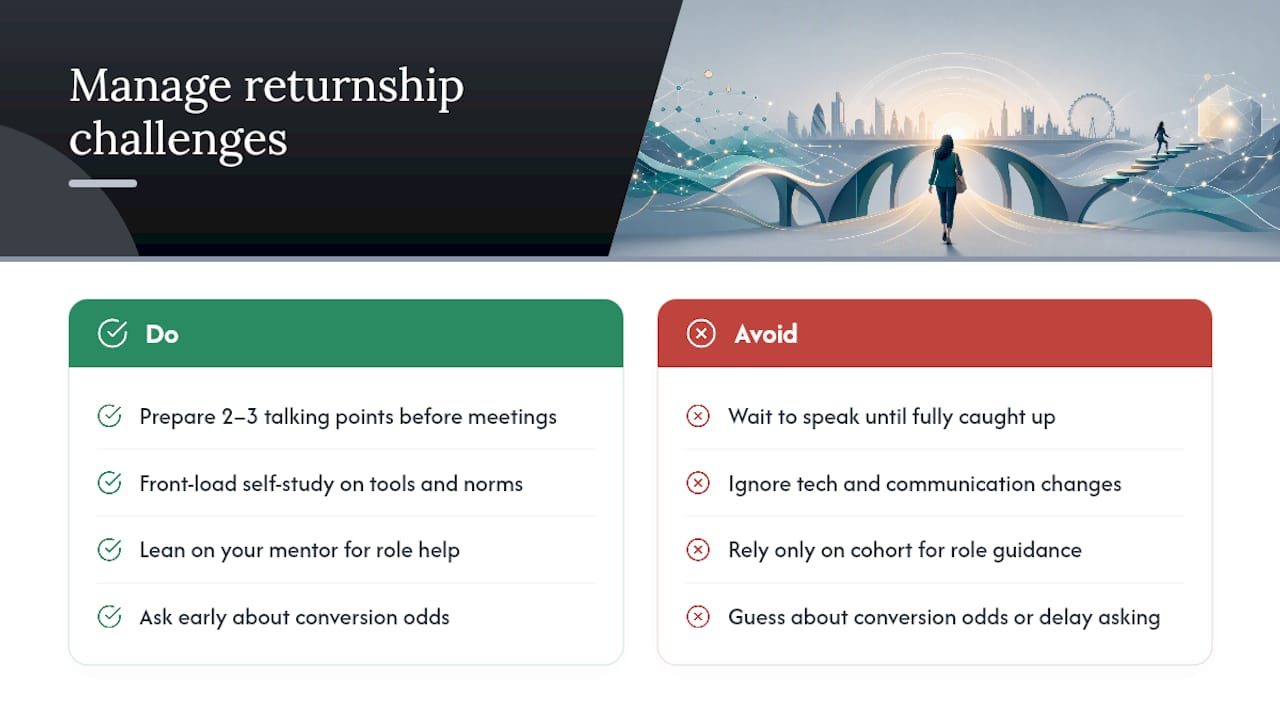
The most common struggle is confidence, not competence. Returners often assume their skills have decayed more than they have, which shows up as hesitancy in meetings during the first few weeks. The fix is mechanical: prepare two or three talking points before every meeting so you contribute early, rather than waiting until you feel fully caught up.
A second challenge is technology drift. Software, internal tools, and even communication norms (Slack etiquette, async meeting culture) shift fast over a two or three year break. Front load your prep here specifically, since this is the gap employers notice fastest and the one you can close before day one with a few hours of self-study.
Cohort dynamics can also be uneven. Not every peer in your cohort will be at the same seniority level or have the same functional background, which can make networking feel mismatched at first. Lean on your assigned mentor rather than the broader cohort for role-specific guidance, and use cohort peers for the emotional and logistical side of reentry instead.
Finally, ambiguity about conversion odds creates real stress for people who need income certainty. Ask directly and early rather than guessing, and treat the fellowship period itself as valuable resume-building regardless of the outcome.
How Returnships Support Diversity and Inclusion Goals
Career breaks disproportionately affect women, particularly around caregiving, which means a hiring pipeline that penalizes employment gaps quietly filters out a specific demographic before an interview ever happens. Returnship programs exist partly as a structural correction to that pattern.
The effect extends beyond gender. Returnships also open doors for professionals who stepped away for eldercare, chronic illness, immigration transitions, or military service, groups that traditional recruiting funnels routinely underweight. By explicitly designing a hiring path around the career break itself, rather than treating it as a liability to explain away, employers signal that experience gained before the break still counts.
For employers running diversity initiatives, returnships offer something harder metrics struggle to capture: a direct pipeline to experienced, often senior-level talent that standard entry-level diversity hiring cannot reach. A returnship cohort skews toward mid-career and senior professionals, which fills a different gap in representation than graduate recruiting programs typically address.
Which Companies Run Notable Returnship Programs?
Financial services firms were early movers in this space and remain some of the most visible names running structured cohorts. Goldman Sachs’s Returnship program is one of the longest-running examples, built specifically around paid, short-term fellowships for career returners. JPMorgan Chase’s ReEntry Program runs on a similar model, with a defined 15-week structure and explicit mentorship built into onboarding.
Morgan Stanley runs its own Return to Work program on a comparable cohort schedule, while BlackRock’s Career Returnship Program extends the model into EMEA regions, showing that returnships are not exclusively a US phenomenon even though many of the largest programs originated there.
Beyond finance, technology and engineering firms have adopted the same structure, often under different program names, reflecting how the returnship model has spread as a recognized hiring practice rather than a niche experiment tied to one industry.
Job Tide’s Role in Finding the Right Returnship Fit
Tracking cohort windows across a dozen employer pages by hand is exactly the kind of scattered search Jobtide was built to fix. Instead of bookmarking individual careers pages and hoping you check them at the right moment, you can set filters for career-return roles, cohort length, and paid status, and let personalized matching surface relevant openings as they appear.
That matters most for returners juggling limited time and high stakes. A platform that centralizes discovery across employers, rather than forcing you to monitor each one separately, cuts the duplicate effort out of an already demanding search. Setting saved alerts means you find out about a new cohort window the day it opens, not weeks after applications close.
Practical next step: create a profile, set your filters for paid, cohort-based, career-return roles, and let the alerts do the monitoring work your calendar reminders currently handle manually.
Getting Back to Work Without Guessing
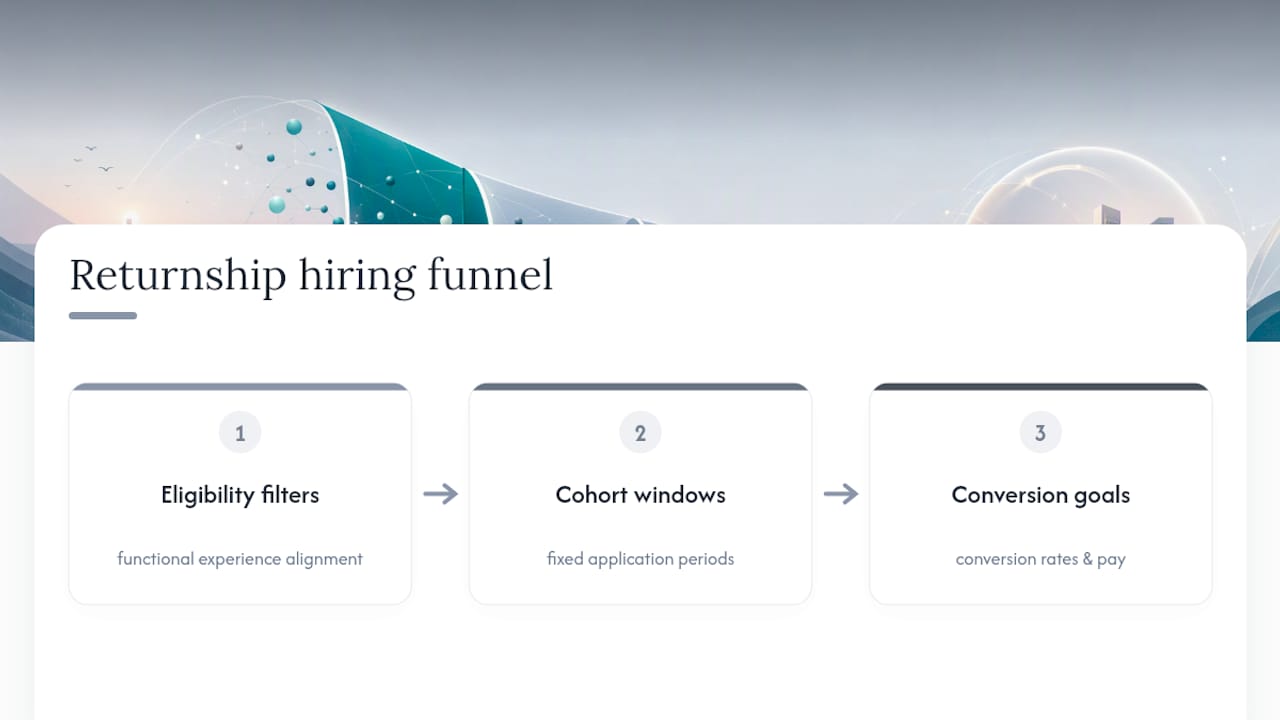
Most advice on career reentry focuses on the emotional side of returning, confidence, imposter syndrome, explaining the gap. That matters, but it undersells the mechanical reality: returnships are structured hiring funnels with specific eligibility filters, fixed cohort windows, and conversion goals that employers rarely advertise loudly. Treating the search like a systems problem, not just a confidence problem, is what separates returners who land offers from those who apply broadly and wonder why nothing lands.
The overlooked detail is functional matching. Professionals often assume any returnship is better than none, so they apply to whatever cohort is open rather than the one that matches their actual background. The data on this is consistent: aligning your application to prior functional experience beats generic returner positioning almost every time. A finance professional applying to a finance-adjacent returnship has a real shot. The same professional applying to a general “returner” pool competing against candidates from unrelated fields does not.
The other underappreciated point: returnships are not charity. Employers run them because the economics work, mentoring a proven professional back into productivity is cheaper than training a new hire from scratch. That should give you leverage in interviews, not just gratitude. Ask about conversion rates. Ask about pay transparently. Treat the program as a two-way evaluation, because it is one.
— Alisher
Find Cohort-Based Returnship Opportunities With Jobtide
A platform can help returning professionals find paid, cohort-based opportunities without checking multiple employer pages manually. Rather than searching through generic job boards where returnship listings may be hard to find, filtering by career-return roles, cohort length, and pay status, and receiving recommendations matched to background and seniority can improve the job search experience.
That fit matters more here than in a typical job search. A mismatched returnship application wastes weeks of a limited window, while a well-matched one puts you in front of a mentor and a real evaluation period. Personalized recommendations can reduce mismatch by saving time filtering irrelevant listings and allowing more focus on preparing for roles that match experience.
If you’re ready to stop tracking employer pages by hand, set up your profile on Jobtide and configure your filters for paid, cohort-based career-return roles today.
Sources
Help shape JobTide.
Tell us about your job search in our early-access questionnaire. JobTide is in development; completing it does not generate a resume.
Start my questionnaire →