Startup Job Boards: Where to Look and How to Apply

Help shape a future CV tailoring tool. Start the JobTide early-access questionnaire →
Your best first move is to build a profile on a recommendation-first platform like Jobtide, then check two supporting sources: a VC or accelerator board for funded roles, and a niche community board for cultural fit. Personalized filters and matching save you from scrolling through hundreds of listings and put the roles that actually fit your skills in front of you faster.
TL;DR:
- Narrow niche and community boards offer more relevant, culturally fitting listings, especially for technical roles or specific industries.
- Setting precise filters and enabling real-time alerts significantly increases chances of applying early to startup roles before they fill.
- Before applying, verify clarity of role, disclosed compensation, team growth signals, and leadership transparency to avoid poor-fit opportunities.
- Craft outreach messages with a clear impact statement, relevant portfolio links, and specific asks to stand out to small startup hiring teams.
- Using platforms like Jobtide automates personalized matching, focusing your effort on high-quality roles rather than wasting time on broad searches.
Table of Contents
- What types of startup job boards exist, and when should you use each?
- How do you search and filter startup job boards without wasting time?
- How do you evaluate a startup posting before you apply?
- What should your application and outreach look like for startup roles?
- How do you keep up with new startup job listings without checking five sites a day?
- Why curated, recommendation-first boards will matter more for startup hiring
- Get started on Jobtide and stop guessing which startup roles fit
- Sources
What types of startup job boards exist, and when should you use each?
Not every board sources listings the same way, and that difference determines whether you find a role in a day or waste a week.
Community and niche boards curate listings around a specific stack, industry, or worker type (designers, engineers, marketers). They carry less noise than general job sites, and the postings tend to reflect real cultural fit because the board’s audience is narrow to begin with.
VC and accelerator boards pull postings directly from portfolio companies. Y Combinator’s Jobs hub is the clearest example: it lets you apply to many funded startups with a single profile and gives resume feedback tailored to how startups actually screen candidates. If you want equity-heavy comp packages or early-stage roles, this is where funded companies post first.

Aggregators and feeds scrape listings from many sources at once. They win on volume and speed, catching roles within hours of posting, but they also carry more duplicate and stale listings. Filters and alerts matter more here than anywhere else.
Company career pages and platforms like GitHub or Dribbble sometimes carry founder-posted roles that never make it to a board at all, especially for technical or design hires where a founder wants to see work samples directly.
The practical rule: match the board type to your goal.
- Chasing early-stage equity or a broad title? Apply wide across aggregators and VC boards.
- Targeting a senior or scarce-skill role? Go selective, work the niche boards, and read every posting closely before applying.
- Want the filtering done for you? A platform like Jobtide handles the matching layer across sources so you are not manually cross-checking five sites a day.
How do you search and filter startup job boards without wasting time?
Precision at the filter stage is what separates a productive job search from a scroll-and-hope routine. Search technology like Algolia powers the fast, filtered search behind many job sites, which means the filters you set are only as good as how specifically you set them.
- Set precise filters first. Role, seniority, remote policy, visa or relocation needs, and whether you’re optimizing for salary or equity. Vague filters return vague results.
- Save your searches and turn on alerts. Email, Slack, or push notifications matter because startup roles fill fast. A posting that’s three days old may already have a shortlist.
- Check high-signal listings within 24 hours. Startups move quickly on candidates who respond quickly. Waiting a week to reply to a strong match often means the role is gone.
- Rebuild your profile around impact, not tenure. One line summarizing what you do, three or four metric-driven bullets (“cut onboarding time 30%,” “shipped feature used by 12,000 users”), and public portfolio links or a short demo video.
- Know when to automate and when to slow down. Bulk-applying works once you’ve personalized the opening message. If a posting is vague on scope or comp, skip the form and reach out to the founder or hiring lead directly instead.
Pro Tip: Keep a simple tracking document, just company, role, date applied, outreach sent, and response. It takes two minutes per entry and saves you from re-messaging the same founder twice, which happens more often than you’d think once you’re active on four or five boards at once.
How do you evaluate a startup posting before you apply?
A posting can look exciting and still be a poor bet. Run it through a short checklist before you spend an evening tailoring an application.
- Role clarity. Can you tell what success looks like in the first quarter, or is the listing a grab-bag of responsibilities?
- Disclosed compensation or equity. Boards that flag salary and visa policy up front, like NewJob does, save you from finding out the range is wrong for you after three interview rounds.
- Team size and recent hires. A team that just hired five people for the same function in one month is either scaling fast or churning fast. Ask which.
- Public funding signals. A recent raise, a named lead investor, or a public Series A announcement tells you more about runway than the posting itself will.
- Leadership transparency. Founders who answer direct questions about growth stage and financial health in a screening call are a good sign. Y Combinator’s own advice to job seekers recommends asking exactly these questions before you commit.
Salary transparency remains the exception, not the rule, at most companies. An industry summary found that 79% of general job postings withhold salary until later interview rounds. Startup-focused boards tend to do better on this front, so when you’re choosing between two similar postings, the one that discloses a range deserves your time first.
In your first outreach or screening call, ask who you’ll report to, what success looks like in six to twelve months, and how the company’s runway connects to this hire. Founders who dodge that last question are telling you something.
What should your application and outreach look like for startup roles?
Startups read applications differently than large companies do. A hiring manager at a 12-person company is often the founder, and they’re scanning for signal, not keywords.
- Lead with a one-line summary of what you do. Not a job title. A sentence: “I build onboarding flows that cut drop-off by double digits.”
- Back it with three or four impact bullets. Numbers beat adjectives every time.
- Attach one or two relevant portfolio links. A live product, a GitHub repo, a Figma file, a campaign report. Skip the generic resume PDF if you have something better.
- State your availability and comp expectations plainly. It saves both sides a round of guessing, and it signals you’ve thought about the shape of the offer you want.
- Structure your outreach message in three parts. Open with a genuine hook (something specific about the company, not “I saw your posting”), follow with one or two impact bullets, then close with a single clear ask: a 15-minute intro call or the next concrete step. Once you’re past the first screen, a scheduling link (Calendly works fine) removes the back-and-forth over times.
- Follow up on a cadence. A polite nudge at five to seven days, a final one at ten to fourteen, then move on.
Tailor the framing by role: engineers lead with a shipped feature and its metric, designers lead with a portfolio link and the problem it solved, growth and marketing candidates lead with a number tied to acquisition or retention.
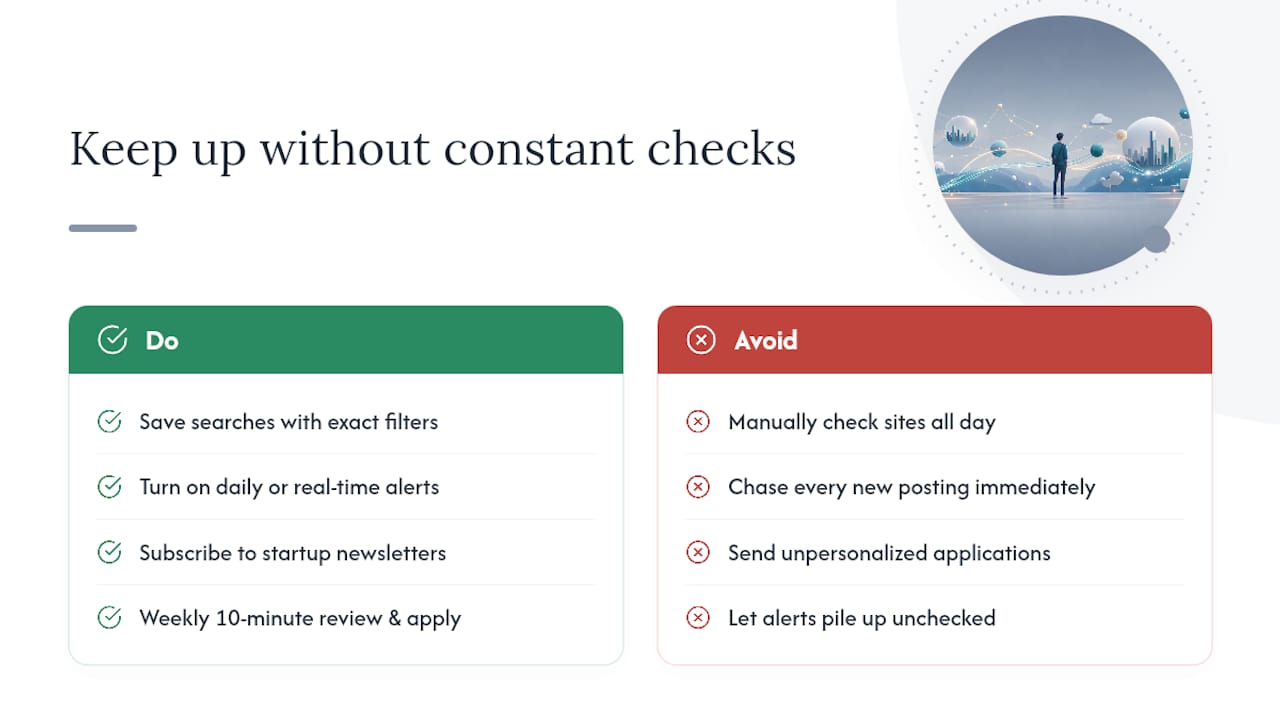
How do you keep up with new startup job listings without checking five sites a day?
New roles at fast-growing companies often fill within days, so the real skill isn’t finding boards. It’s catching listings early enough to act on them.
Alerts do most of the work if you set them up correctly. Save a search with your exact filters (role, remote policy, seniority) on each board you use, and turn on daily or real-time notifications rather than checking manually. A recommendation-first platform folds this into your profile automatically, sending matches instead of requiring you to re-search the same terms every morning.
Newsletters fill the gap that alerts miss, especially for accelerator-backed roles. YC’s own Jobs hub and its broader Startup School resources surface curated openings and context on what startups expect from candidates, which is useful even outside an active job search.
A short weekly habit works better than constant checking: ten minutes on a Monday to review new alerts, apply to the two or three that fit best, and update your tracking document. Chasing every new posting the moment it appears leads to burnout and sloppy, unpersonalized applications, which startups notice immediately.
Why curated, recommendation-first boards will matter more for startup hiring
AI matching is already cutting down on wasted applications by surfacing roles that fit your actual skills rather than ones that merely match a keyword. That trend will accelerate, not fade, as more platforms build recommendation layers on top of raw listings.
Salary transparency is heading the same direction. Boards that disclose comp early aren’t just being generous. They’re competing for better applicants, and that pressure will keep pushing more listings toward disclosure.
The candidates who benefit most won’t be the ones applying to everything. They’ll be the ones who tighten their profile signal and reach out to founders early, before a role has fifty applicants deep in a queue.
— Alisher
Get started on Jobtide and stop guessing which startup roles fit
Jobtide replaces the scattershot approach of checking five boards a day with one profile that does the matching for you. Instead of manually filtering aggregator feeds for remote policy, equity structure, and seniority, you set your preferences once and let personalized recommendations surface the roles worth your time.
The platform’s filtering tools cover the same criteria this guide walks through: role type, remote versus on-site, seniority, and compensation shape, so you’re not re-reading vague postings to figure out if a role fits. Tailored alerts mean you hear about a strong match the day it’s posted, not a week later when the shortlist is already set. And because Jobtide is built around candidate fit rather than volume, your profile signal (the impact bullets and portfolio links this article recommends) carries more weight in what gets recommended to you.
Getting started takes three steps: sign up on Jobtide, build a concise profile with your impact summary and portfolio links, then set your filters and alerts. From there, targeted recommendations start coming to you instead of the other way around.
Sources
Help shape JobTide.
Tell us about your job search in our early-access questionnaire. JobTide is in development; completing it does not generate a resume.
Start my questionnaire →