10 Transferable Skills Examples With CV Ready Bullet Points

Help shape a future CV tailoring tool. Start the JobTide early-access questionnaire →
Transferable skills are the abilities you carry from one job, industry, or life role into another, things like communication, problem solving, or project coordination. Listing them by name rarely convinces anyone; showing them through a specific, measurable example almost always does. This article gives you both: a clear breakdown of what counts as a transferable skill, and ready-to-use CV phrasing built around real outcomes.
TL;DR:
- Transferable skills like communication, problem solving, and leadership are validated through measurable examples, not just listing them by name.
- Using a skills-based or hybrid resume format highlights relevant strengths upfront, helping career changers bypass unrelated job titles.
- Focusing on core categories such as communication, leadership, and analysis improves CV clarity and allows tailored grouping of skills.
- Practical CV bullets should link skills to specific results, like reducing delays or increasing satisfaction, to demonstrate real impact.
- Identifying transferable skills in non-professional experiences and applying a STAR approach can uncover strengths often overlooked.
Table of Contents
- What Are Transferable Skills Examples, and How Do They Differ From Job-Specific Skills?
- Why Employers Care About Transferable Skills During a Career Switch
- The Main Categories of Transferable Skills You Should Know
- Transferable Skills Examples You Can Copy Into Your CV
- How to Identify Your Own Transferable Skills
- How to Show Transferable Skills on Your CV and Cover Letter
- Why a Skills-First Perspective Changes How You Job Search
- Your Elevator Pitch: Framing Transferable Skills Out Loud
- Turn Your Transferable Skills Into Real Job Matches
- Where to Go for Templates and Deeper Guidance
- Sources
- FAQ
What Are Transferable Skills Examples, and How Do They Differ From Job-Specific Skills?
A transferable skill works across roles and industries because it’s about how you operate, not what you operate. A job-specific skill, sometimes called a technical or hard skill, only applies within a narrow context: coding in Python, operating a forklift, reading an X-ray. Project management, on the other hand, functions whether you’re organizing a product launch or coordinating a school fundraiser.
Here’s the quick contrast that trips people up most often:
- Transferable: negotiation, conflict resolution, budgeting, public speaking, data analysis, coaching others.
- Job-specific: SQL queries, CNC machine operation, tax code compliance, MRI interpretation, Adobe InDesign layout.
- Gray area: “customer service software” is job-specific, but the de-escalation skill behind it is transferable.
You’ll also see transferable skills called soft skills or core skills, depending on the source. The terms overlap but aren’t identical. Soft skills usually mean interpersonal traits (empathy, patience); transferable skills is the broader umbrella that also includes things like financial analysis or basic coding logic, provided the skill isn’t tied to one employer’s specific tools.
These skills show up in three places that matter for your job search: your CV’s skills summary and bullet points, your interview answers when a hiring manager asks “tell me about a time,” and your networking conversations when you need to explain your background in under 30 seconds without sounding like a job title recap.
Why Employers Care About Transferable Skills During a Career Switch
Hiring managers use transferable skills as a proxy for a question they can’t ask directly: will this person figure things out without months of hand-holding? A candidate switching from retail management to project coordination hasn’t run a Gantt chart before, but if they’ve handled staff scheduling, inventory deadlines, and customer escalations, the adaptability signal is already there.
Statistic Callout: The World Economic Forum’s Future of Jobs Report 2025 names communication, problem solving, and adaptability among the skill categories employers expect to matter most as roles get reshaped by automation and shifting business models. That’s not a niche finding limited to tech. It cuts across sectors, which is exactly why a transferable-skills-first CV survives industry changes better than a resume built entirely around one job title.
There’s a practical mechanic behind this too. Applicant tracking systems scan for keywords, and many of those keywords are transferable skill terms rather than tool names. A resume heavy on “collaborated,” “resolved,” and “streamlined operations” often clears automated screens that a duties-only list misses. Beyond the algorithm, transferable skills predict faster onboarding, smoother cross-team work, and fewer escalations to a manager, three things every hiring manager is quietly grading for even when the job ad doesn’t say so.
The Main Categories of Transferable Skills You Should Know
Grouping your skills into categories, rather than dumping them into one long list, makes your CV easier to scan and helps you avoid repeating the same strength five different ways. Most transferable skills fall into six clusters.
- Communication: writing, presenting, active listening, persuasion. Shows up in client calls, reports, and cross-department updates.
- Leadership and people skills: delegation, mentoring, conflict resolution, team motivation. Relevant even without a formal management title, think shift leads, team captains, or volunteer coordinators.
- Analytical and problem solving: data interpretation, root-cause analysis, decision making under uncertainty. Common in operations, finance, and research-adjacent roles.
- Organization and time management: prioritization, multitasking, meeting deadlines under competing demands. Useful in almost every job description ever written.
- Digital and technical literacy: spreadsheet modeling, CRM use, basic data visualization. Not the same as deep technical expertise, but proof you’re not intimidated by new systems.
- Creativity and initiative: process improvement, campaign ideas, spotting gaps nobody assigned you to fix. Often the most underused category on career-change resumes.
For a CV, pick three or four of these clusters, not all six, and build a subheading or grouped bullet set under each. A recruiter skimming for 20 seconds should be able to tell instantly which clusters you’re strongest in, rather than parsing a flat list of twelve adjectives with no hierarchy.
Transferable Skills Examples You Can Copy Into Your CV
Each example below pairs a definition with a CV-ready bullet built around a measurable result, since a bare skill name rarely convinces anyone on its own.
-
Communication. Definition: getting information across clearly to different audiences. CV bullet: “Presented weekly performance updates to a 12-person team, cutting follow-up clarification emails by roughly a third.” Tailoring tip: match the audience type (client-facing vs. internal) to the audience named in the job posting.
-
Problem solving. Definition: diagnosing an issue and choosing a workable fix under real constraints. CV bullet: “Identified a recurring scheduling conflict affecting 40 weekly shifts and redesigned the rota, eliminating the issue within two weeks.” Tailoring tip: name the constraint (time, budget, staff) that made the problem hard.
-
Leadership. Definition: guiding others toward a shared outcome, with or without formal authority. CV bullet: “Delegated tasks across a team of five to improve project delivery time by 15%,” a phrasing style echoed directly in guidance from jobs.ac.uk on CV skills. Tailoring tip: swap “team of five” for the actual headcount you led, even informally.
-
Teamwork. Definition: contributing effectively inside a group with shared goals. CV bullet: “Coordinated with three departments to launch a customer feedback process, reducing complaint resolution time from five days to two.” Tailoring tip: name the departments or roles involved, not just “collaborated with others.”
-
Time management. Definition: prioritizing tasks to hit deadlines without sacrificing quality. CV bullet: “Managed overlapping deadlines across four concurrent projects, delivering all on schedule over a six-month period.” Tailoring tip: use a real timeframe, since vague duration undercuts the claim.
-
Analytical thinking. Definition: breaking down data or situations to reach a sound conclusion. CV bullet: “Analyzed customer purchase patterns across 2,000 transactions to recommend a stock adjustment that reduced overstock by 18%.” Tailoring tip: mention the data volume if you have it; it signals scale.
-
Digital literacy. Definition: comfort learning and using new software or platforms. CV bullet: “Migrated team scheduling from spreadsheets to a shared CRM, cutting manual entry time by 5 hours per week.” Tailoring tip: name the specific tool only if the target job lists a similar one.
-
Adaptability. Definition: adjusting approach when circumstances shift. CV bullet: “Restructured onboarding materials within 48 hours after a policy change, keeping training on schedule for 20 new hires.” Tailoring tip: pair adaptability with a concrete trigger event, not a vague “handled change well.”
-
Attention to detail. Definition: catching errors or inconsistencies others miss. CV bullet: “Reviewed 150+ monthly invoices, identifying discrepancies that recovered $3,200 in billing errors.” Tailoring tip: quantify the review volume; it’s more convincing than “meticulous.”
-
Project management. Definition: planning and running a body of work from start to finish. CV bullet: “Led a cross-functional office relocation involving 60 staff, completed on budget and one week ahead of schedule.” Tailoring tip: even informal projects (an event, a move, a process rollout) count if you owned the timeline.
Pro Tip: *Whenever you’re stuck between two verbs, pick the one closer to a number. “Improved communication” is forgettable.
How to Identify Your Own Transferable Skills
Most people undersell their transferable skills simply because they’ve never written them down outside a job description. A short STAR-style exercise, Situation, Task, Action, Result, forces the language out of you.
-
List five moments, not job titles. Think of specific incidents: a tight deadline, a conflict you resolved, a process you improved. A job title tells you nothing; a moment reveals the skill.
-
Apply Situation → Task → Action → Result to each one. What was happening (Situation), what were you responsible for (Task), what did you actually do (Action), and what changed because of it (Result)? The skill usually reveals itself in the Action step.
-
Look beyond paid work. Volunteering, coursework, side projects, and even hobbies generate real transferable skills. Guidance for young carers, for instance, shows how caregiving responsibilities translate directly into scheduling, budgeting, and crisis management skills that Carers UK documents as legitimate CV material. The Open University’s employability resources offer similar structured exercises for pulling skills out of everyday experience.
-
Rank your list against the job description. Not every skill you uncover deserves equal space. If the posting mentions “cross-functional coordination” twice, that example goes near the top of your skills summary; a skill the posting never mentions goes lower or gets cut.
Run this exercise for five to eight moments and you’ll usually surface more usable material than a generic “what are your strengths” brainstorm ever produces.
How to Show Transferable Skills on Your CV and Cover Letter
Career changers face a specific formatting problem: a strict chronological resume buries their most relevant experience under an unrelated job title. A hybrid, or combination, format solves this by leading with a skills summary and professional profile, then following with a condensed work history. Career-change guidance from Wharton Online Insights recommends exactly this structure because it lets a hiring manager see relevant strengths before they hit a job title that might read as a mismatch.
Structure your skills summary as three or four clusters (from the categories covered earlier), each with one metric-backed bullet underneath. Keep technical or tool-specific skills in a separate line so they don’t get diluted among the transferable ones, a distinction jobs.ac.uk’s CV guidance also flags as worth keeping clear.
Two quick before-and-after rewrites show the difference:
- Before: “Responsible for team communication and scheduling.” After: “Coordinated weekly schedules for a team of 8, reducing shift conflicts by 25% over three months.”
- Before: “Helped with customer issues.” After: “Resolved an average of 30 customer escalations weekly, maintaining a 95% satisfaction rating.”
For your cover letter, one sentence can do the bridging work a full resume can’t:
That single sentence tells the employer exactly which transferable skills to expect before they even open the attached resume.
Why a Skills-First Perspective Changes How You Job Search
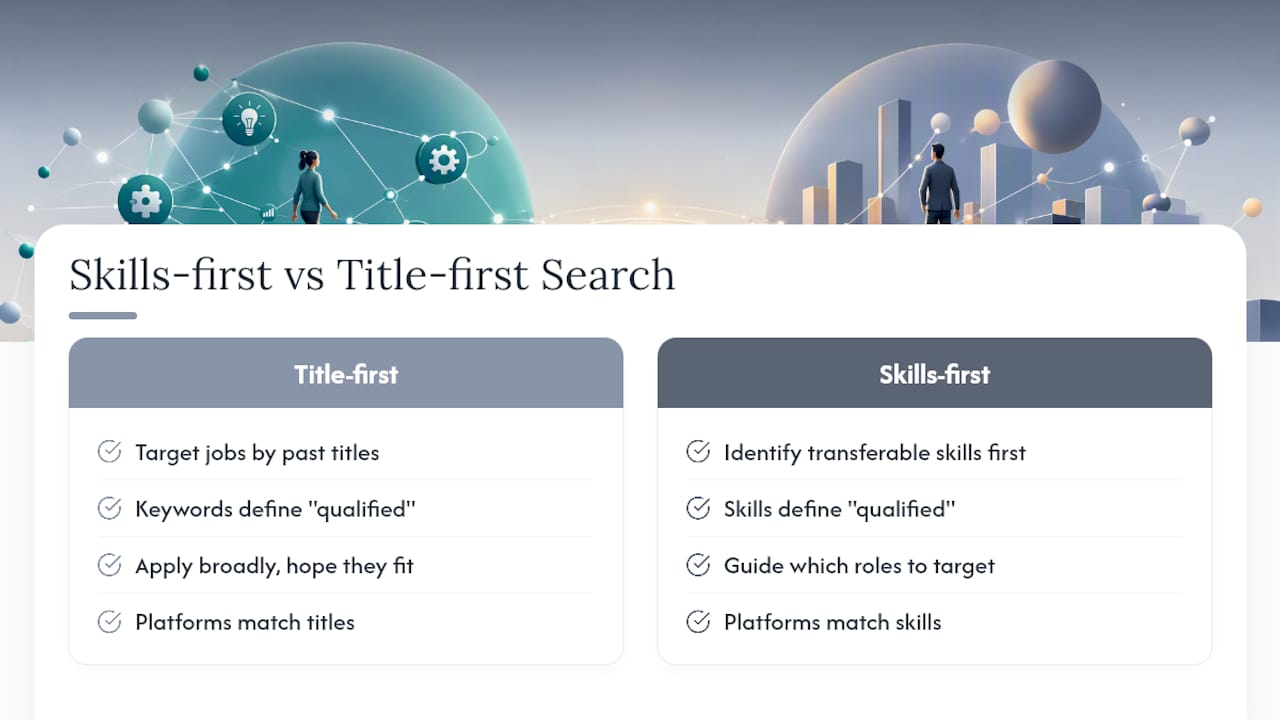
Alisher, who covers job search strategy for Job Tide, argues that most career-change advice still treats transferable skills as a resume afterthought rather than a search strategy. The stronger approach flips that: identify your transferable skills first, then let them guide which roles you target, instead of applying broadly and hoping your background eventually makes sense to someone.
That shift matters because a skills-first search changes what “qualified” means. A candidate who can show delegation, budget ownership, and process improvement often qualifies for more adjacent roles than a keyword search on job titles alone would ever surface. Platforms built around skill matching, rather than title matching, are designed around exactly this insight: your next role is often defined by what you can do, not what your last job was called.
Your Elevator Pitch: Framing Transferable Skills Out Loud
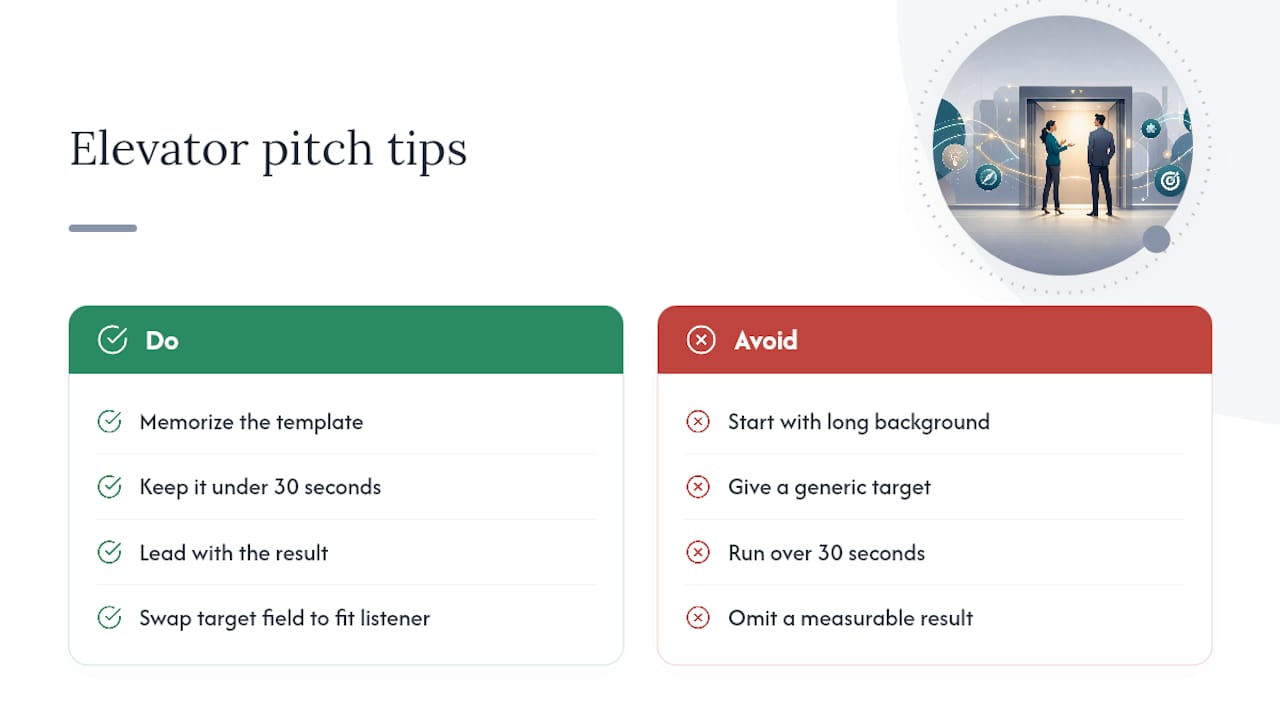
Here’s a template worth memorizing for networking events or the opening seconds of an interview: “I’ve spent [X years] in [field], where I built strong [skill one] and [skill two], shown by [one measurable result]. I’m now looking to apply that in [target field/role].”
Keep it under 30 seconds, lead with the result, and swap the target field to match whoever’s asking.
— Alisher
Turn Your Transferable Skills Into Real Job Matches
Writing strong CV bullets is only half the battle. The harder part is finding roles where your transferable skills, not your last job title, are actually the deciding factor, and most job boards aren’t built to surface that. Some platforms filter listings by the skills and preferences you enter rather than sorting purely by job title, which matters most for career changers whose title history doesn’t map cleanly onto where they want to go next.
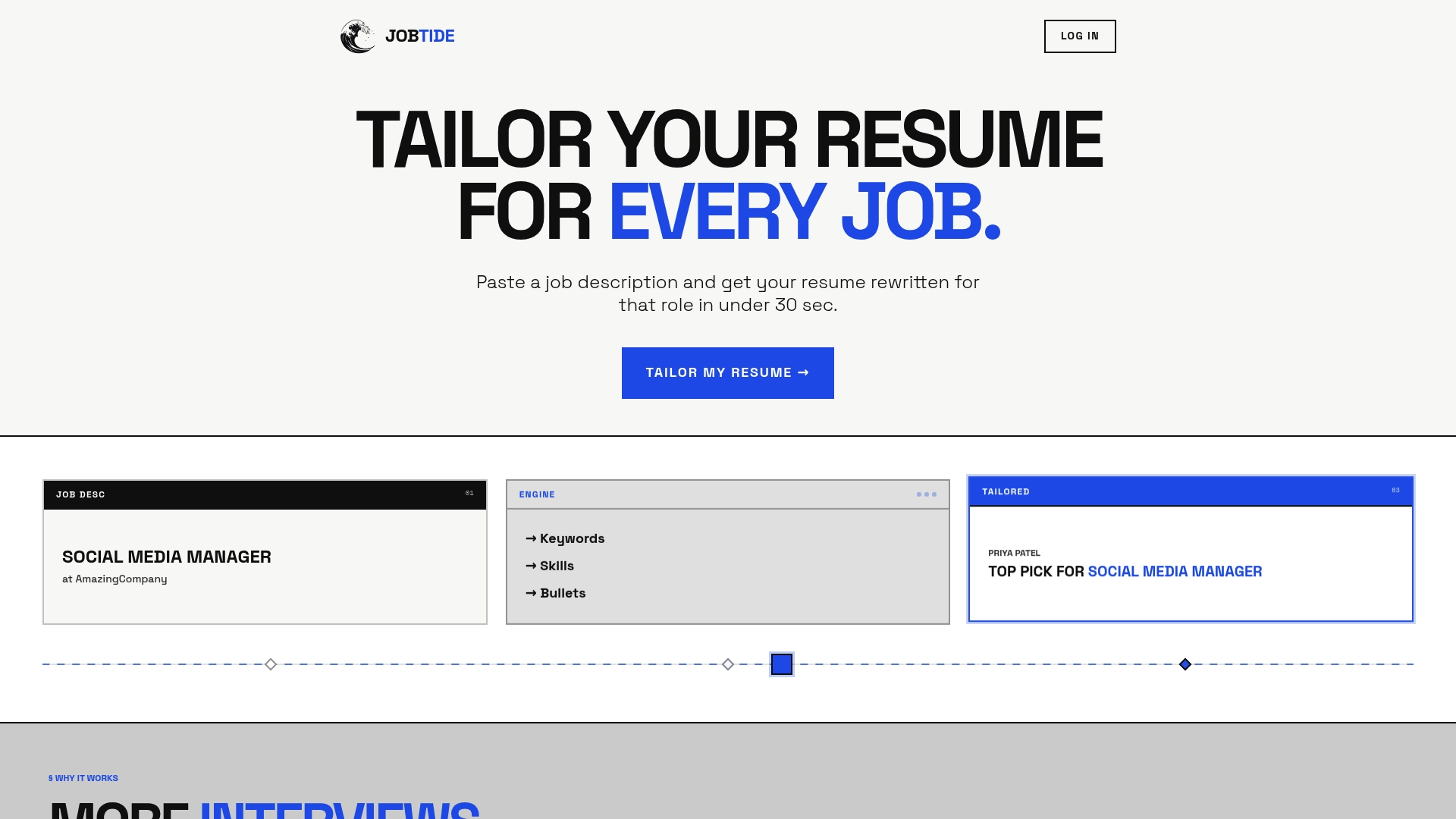
Some platforms allow you to test more than one version of your CV against different role types and see which framing pulls better matches, providing a faster feedback loop than sending many applications without response. If you’ve just rebuilt your skills summary using the examples above, this is the moment to see what it opens up. Check current listings on Job Tide and filter by the transferable skills you just put into words.
Where to Go for Templates and Deeper Guidance
For CV templates and skill-listing formats, jobs.ac.uk’s skills guide is a solid starting point. For structuring a full career-change resume, see Wharton Online Insights. For labor-market context on which skills are rising in demand, read the World Economic Forum’s Future of Jobs Report.
Sources
- Skills for your CV (jobs.ac.uk)
- How to write a career change resume (Wharton Online Insights)
- The Future of Jobs Report 2025 (World Economic Forum)
FAQ
What are transferable skills?
Transferable skills are abilities like communication, problem solving, and organization that apply across different jobs and industries, rather than being tied to one specific role or tool.
What are examples of the 7 transferable skills employers look for most?
Communication, leadership, problem solving, teamwork, time management, digital literacy, and adaptability appear most consistently across job postings and labor-market forecasts, including the World Economic Forum’s 2025 report.
What are 10 transferable skills I can put on my CV?
Communication, problem solving, leadership, teamwork, time management, analytical thinking, digital literacy, adaptability, attention to detail, and project management all work well when paired with a measurable achievement.
What are the main categories of transferable skills?
Most fall into five or six clusters: communication, leadership and people skills, analytical and problem solving, organization and time management, digital and technical literacy, and creativity and initiative.
How do I identify my own transferable skills if I’ve never had a “professional” job?
Apply a Situation, Task, Action, Result reframe to volunteering, coursework, or hobby projects. Non-work experience, including caregiving, develops real transferable skills that translate directly to CV language.
Should I use a chronological or skills-based resume for a career change?
A hybrid format that leads with a skills summary before your work history generally serves career changers better, since it lets a hiring manager see relevant strengths before an unrelated job title, a structure recommended in Wharton Online Insights’ career-change resume guidance.
Help shape JobTide.
Tell us about your job search in our early-access questionnaire. JobTide is in development; completing it does not generate a resume.
Start my questionnaire →